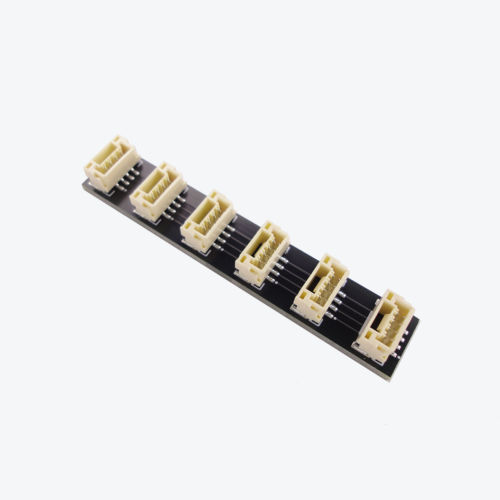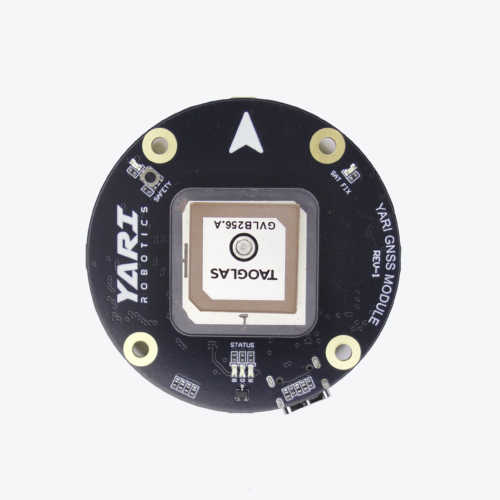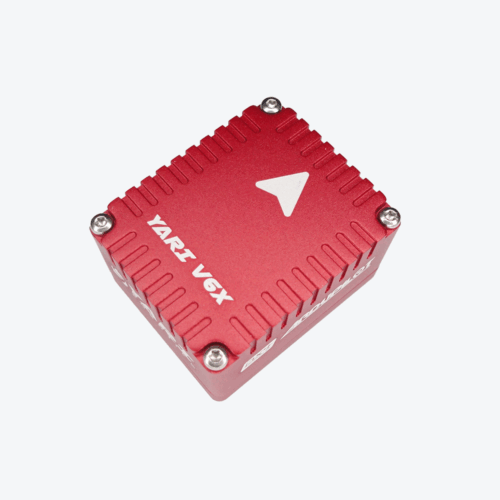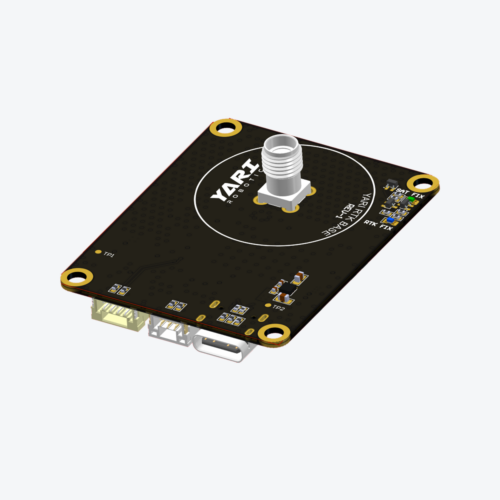
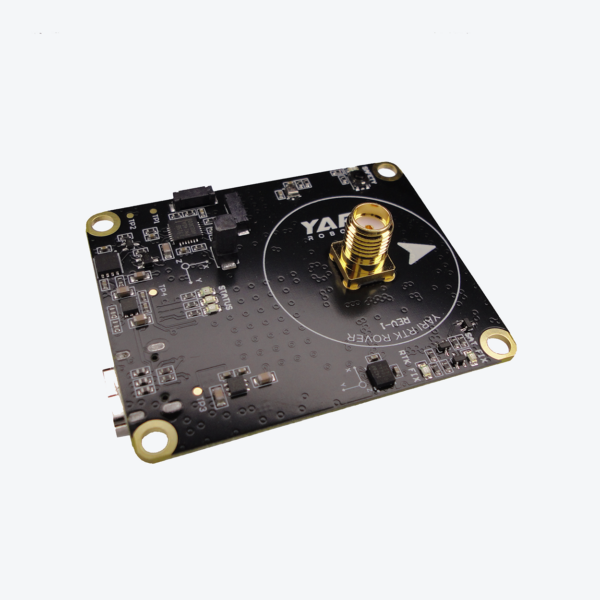
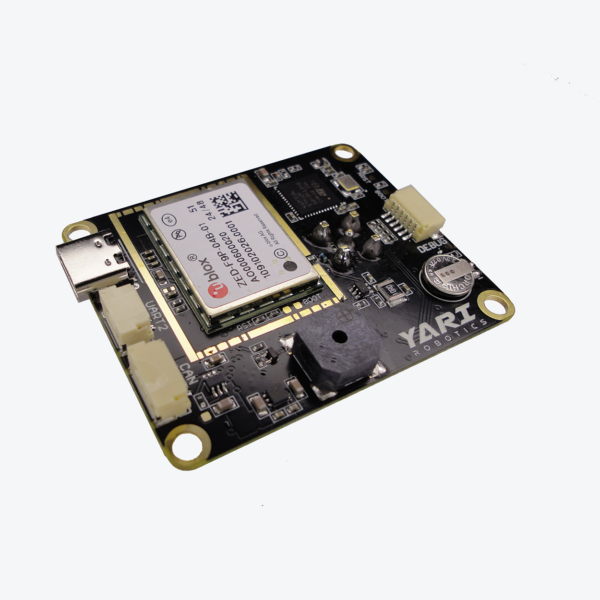
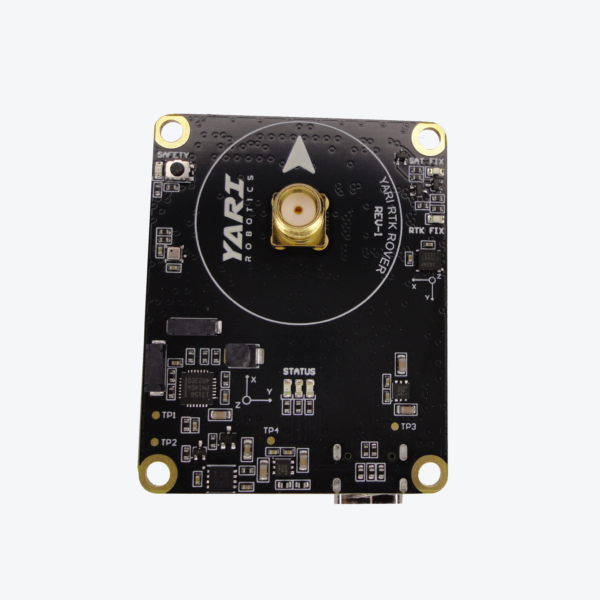
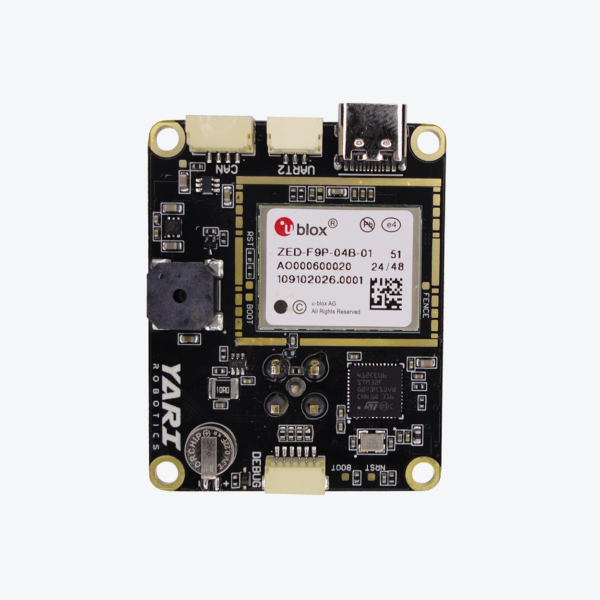
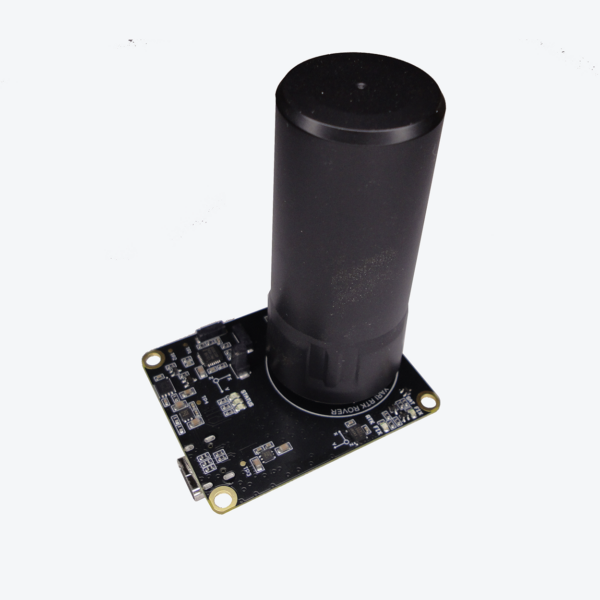
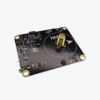
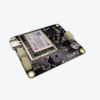
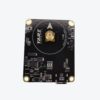
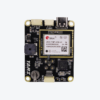
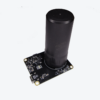
All-in-one RTK rover positioning and navigation node for Pixhawk/ArduPilot systems. Integrates a u-blox ZED-F9P multi-band (L1/L2) high-precision GNSS receiver with an onboard RM3100 magnetometer, barometer, IMU, safety switch, buzzer, and status LEDs over DroneCAN. Provides centimeter-level real-time kinematic (RTK) positioning when paired with an RTK base station or NTRIP corrections. Designed for UAVs, robotics, surveying, and mapping systems that require robust, high-integrity GNSS with integrated sensing.
Key Highlights
- GNSS receiver: u-blox ZED-F9P multi-band (L1/L2) GNSS delivering centimeter-level accuracy in seconds, concurrent GPS/GLONASS/Galileo/BeiDou reception, fast multi-band RTK convergence, high update rates for dynamic applications, energy-efficient operation, and support for moving-base RTK heading.
- Antenna: High-performance helical GNSS antenna (dual/tri-band) connected via a standard SMA connector. Supports direct attachment of antennas up to 27.5 mm diameter; larger or external antennas may be connected using an SMA extension cable.
- RF front end: Uses the integrated u-blox ZED-F9P RF architecture, featuring built-in low-noise amplification, filtering, and advanced multi-band signal processing for robust RTK performance.
- Integrated sensors: PNI RM3100 magnetometer, InvenSense ICP-20100 barometer, and InvenSense ICM-42688-P 6-axis IMU, all published over DroneCAN for seamless integration with ArduPilot and PX4.
- Open-source and flexible: Runs ArduPilot-compatible DroneCAN peripheral firmware for plug-and-play operation with Pixhawk and other DroneCAN-enabled flight controllers.
- Safety and feedback: Tactile safety switch, buzzer, and multicolor LEDs for satellite fix, RTK state, safety state, and system status.
- USB-C port: Provides direct access to u-center for configuration, data logging, and firmware updates.
- Standard connectors: Pixhawk Standard CAN (4-pin JST-GH), Pixhawk Standard Debug (6-pin JST-SH), and USB-C.
Package includes
- 1× YARI RTK ROVER module
- 1× Tri Band (L1/L2/L5) Helical GNSS Antenna
- 1× 4-pin Pixhawk Standard CAN cable
- 1× 3-pin JST-GH cable
Specifications
| Sensors and Processing | |
|---|---|
| GNSS receiver | u-blox ZED-F9P multi-band L1/L2 GNSS |
| Antenna | Helical GNSS antenna (L1/L2/L5) via SMA connector |
| Magnetometer | PNI RM3100 |
| Barometer | InvenSense ICP-20100 |
| IMU | InvenSense ICM-42688-P 6-axis IMU |
| MCU | STM32F412CEU6 |
| Indicators | Safety LED, GNSS Sat-Fix, RTK Status, and RGB System Status |
| Built-ins | Safety switch and buzzer |
| Antenna and RF | |
| Antenna interface | SMA connector for onboard or external GNSS antenna use |
| Supported antenna size | Direct antenna support up to 27.5 mm diameter; larger antennas can be used with an SMA extension |
| RF front end | Integrated ZED-F9P RF architecture with low-noise amplification, filtering, and multi-band signal processing |
| Interfaces | |
| DroneCAN | 1x Pixhawk Standard CAN, 4-pin JST-GH |
| UART2 (F9P) | 1x 3-pin JST-GH |
| Debug | 1x Pixhawk Standard Debug, 6-pin JST-SH |
| USB | 1x USB-C for u-center configuration, data logging, and firmware updates |
| Firmware | ArduPilot-compatible DroneCAN peripheral firmware |
| Electrical and Environmental | |
| Supply voltage | 5 V |
| Current | 170 mA average, 180 mA max |
| Operating temperature | -25 to +85 C |
| Mechanical | |
| Dimensions | 50 (L) x 40 (W) x ? (H) mm |
| Weight | ? |
| Other | |
| Country of origin | India |
GNSS Performance and Bands
| Accuracy and Update Rate | |
|---|---|
| Horizontal accuracy (GNSS only) | 1.0 m CEP typical |
| Horizontal accuracy (RTK fixed) | ~1 cm + 1 ppm CEP |
| Speed accuracy | 0.05 m/s |
| Navigation update rate | Up to 25 Hz |
| RTK modes | Rover, moving-base, and RTK heading use cases |
| Acquisition and Sensitivity | |
| Acquisition | Cold start 24 s; hot start 2 s; aided start 2 s |
| Satellites | 32+ maximum |
| Sensitivity | Tracking/navigation -167 dBm; cold/hot start -148 dBm; reacquisition -160 dBm |
| Frequency Bands | |
| Supported bands | GPS L1 C/A, L2C; GLONASS L1OF, L2OF; BeiDou B1I, B2I; Galileo E1B/C, E5b; QZSS L1 C/A, L2C, L5 when available; SBAS L1 |